Most commonDouble-hang friendly
Reach-In Closets: One Rod, One Shelf, No Excuses
One rod, one shelf, and a door that opens into the foot of the bed. A reach-in is small on purpose, and the trick is spending its height in the right places.
One rod, one shelf, doors that swing out into the room
Updated 12 November 2026
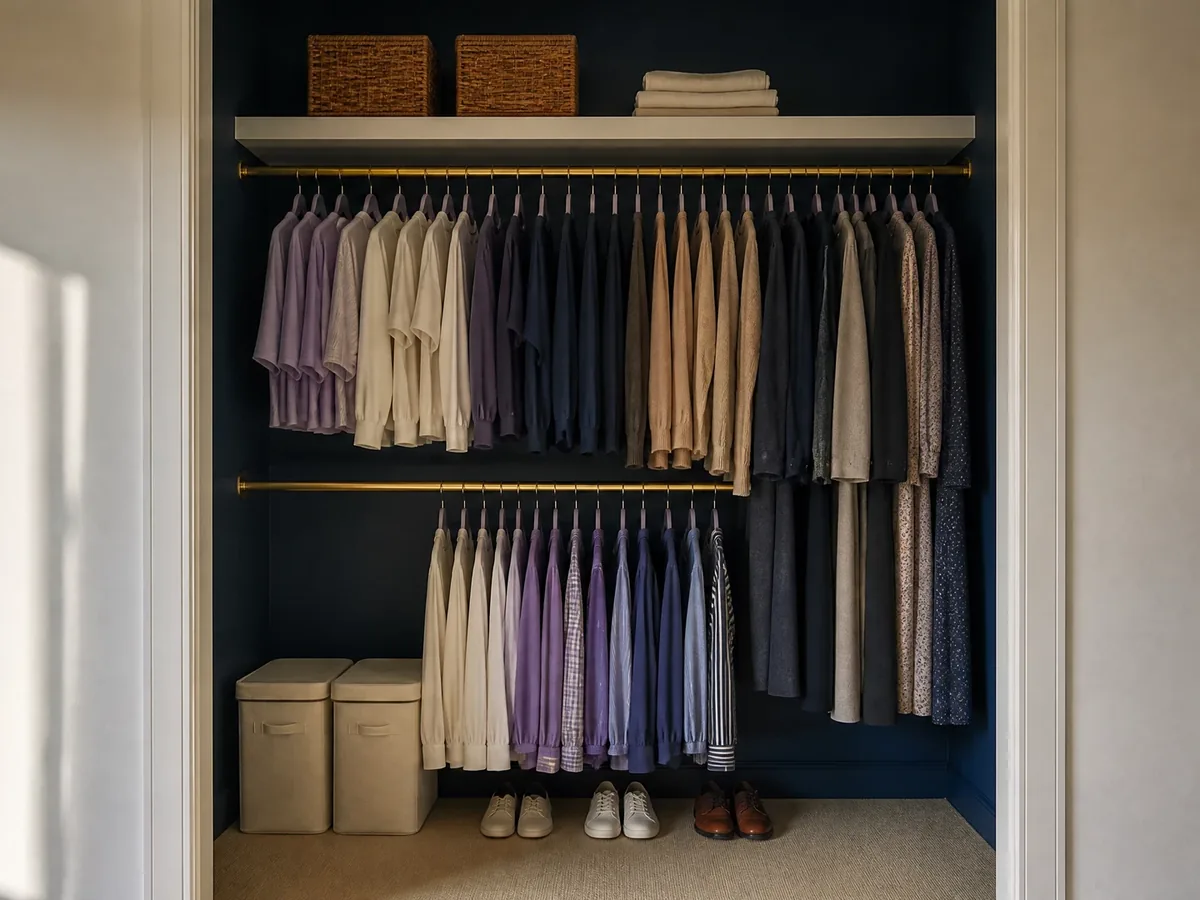
A reach-in closet is the one you stand outside of. Open the doors, step back, work from the doorway: no room to walk in, no light but the bedroom.
That is not a design failure. It is a shallow room with one job: a week of clothes hanging, visible, at arm’s length. If you are unsure which shape you have, the closet types guide starts at the doorway.
What a reach-in actually is
One rod, one shelf above it, a door that swings into the bedroom, and almost never a light. You reach in rather than walk in, so anything behind a coat is gone until spring.
Three measurements decide the rest. Width inside the frame is your total hanger space, minus what the door and trim eat. The rod-to-floor drop is the longest garment the closet can hold, usually shorter than your coat. Depth, back wall to the front of the frame, must let a hanger turn sideways without its shoulder meeting the door.
Split the height, not the colour
The best change costs nothing: stop treating the rod as one long rail. Give coats and dresses a full-drop section at one end, then split the rest into two rods, one near shoulder height and one below, with a gap so hangers clear. Doubling your hanging space covers the tool-free version.
Sort by garment length, not colour. Floor-length, knee-length, short: each group hangs together, and nothing hangs in air that could hold a rail.
Colour-coding fails because you never see it: the closet is viewed edge-on, so the first garment hides the fourth. It also splits apart things that hang the same way, so a long coat between two shirts steals the air above both. If the out-pile beats one bag, the thirty-day declutter plan is slower.
The shelf above the rod
The shelf is not storage. It is a shelf you look up at on tiptoe, where things go to be forgotten. Keep it to bins you can lift with one hand: off-season hats, a folded duvet, paperwork you keep and never read.
The mistake is loading a shelf you cannot see into. Hardbacks, a toolbox, the bag of shoes: above your eyeline, behind a door, over your head. You forget them, then pull them down blind.
Stand where you actually stand and look up. If you cannot see the back edge without crouching, the shelf is too high for anything heavier than a pillow, and the rod below probably is too.
If the shelf rests on pins in tracks, drop it a notch; if it is nailed, leave it.
Doors decide your floor
Bifold doors fold into a zigzag and give the widest opening, but they take the middle of the doorway and stick out into the room. Keep that floor clear and the basket to one side.
Sliding doors need no swing space, and you can reach half the closet at a time. Daily clothes one side, long items the other, so you are not shuffling panels.
Then the door that opens into the bed. If it meets the mattress before it opens fully, the hinge end is your shallowest storage: nothing tall, nothing above shoulder height, nothing overhanging.
What to skip
Built-in towers. A drawer stack inside a reach-in takes rod width from every hanger beside it, and you cannot take it with you.
Anything that needs a drill. Thin walls, trim close to a corner, a shelf over your head: the deposit maths is bad. No-drill ideas do the same work, no holes.
Matching baskets bought before you measure. Sets look uniform in a shop and the closet disagrees: bins overhang the front edge or foul the door. A reach-in refresh on a small budget puts the free jobs first.
Measure these three before anything goes in a cart:
- Width inside the frame, wall to wall, at rod height.
- Rod to floor, tape hanging straight from the rod.
- Depth, back wall to the front of the frame, and the shelf’s clearance above.
What done looks like
Done is the door closing without a sleeve caught in it, weekday clothes between waist and eye height, long things at one end that clear the floor, and floor to stand on while you decide what to wear. A reach-in that does that is finished.
Reach-in closets: questions
How much hanging space does a reach-in closet really have?
As much as the width inside the frame, minus whatever the door and trim eat at each end. It is one rail's worth, which is why the fix is splitting its height rather than adding furniture to the floor.
Can a reach-in closet fit two rods?
Usually on part of the width, not all of it. Keep one section at full drop for coats and dresses, then split the rest into an upper and lower rod with a gap wide enough for hangers to clear.
What belongs on the shelf above the rod?
Light things you can lift down with one hand: a tote of hats and gloves, a folded duvet, a shallow box of paperwork. Nothing heavy, and nothing you cannot see into while standing on the floor.
What if the closet door opens into the bed?
Treat the hinge end as shallow storage. Keep it free of anything tall or stacked above shoulder height, hang long items at the far end, and leave the floor clear so the door swings without catching a basket.