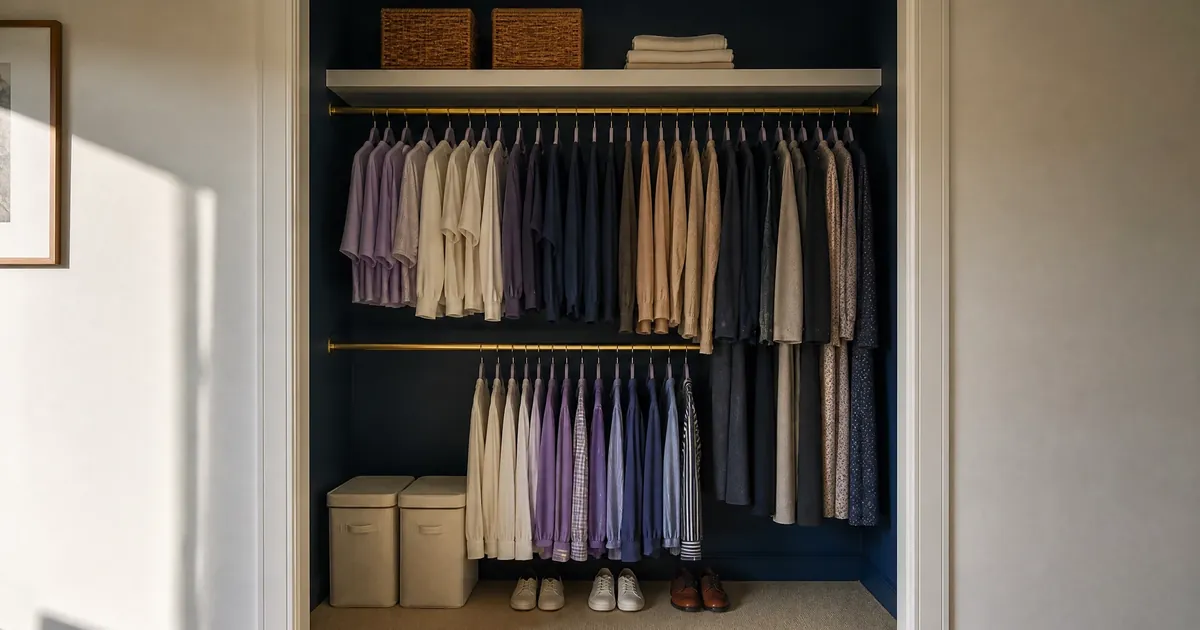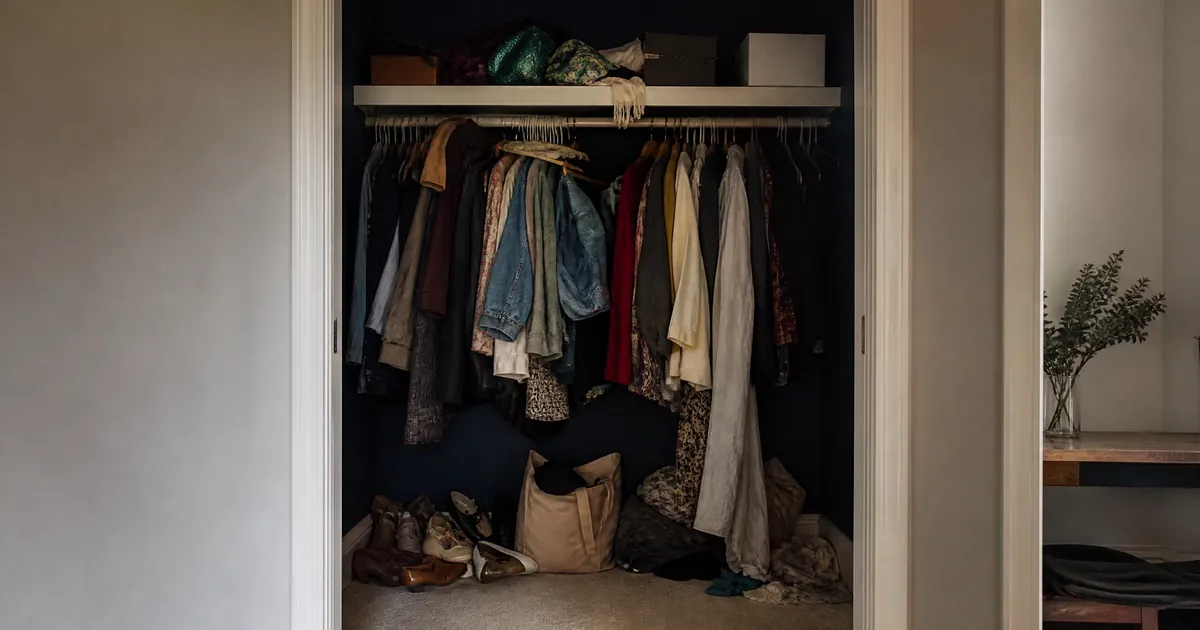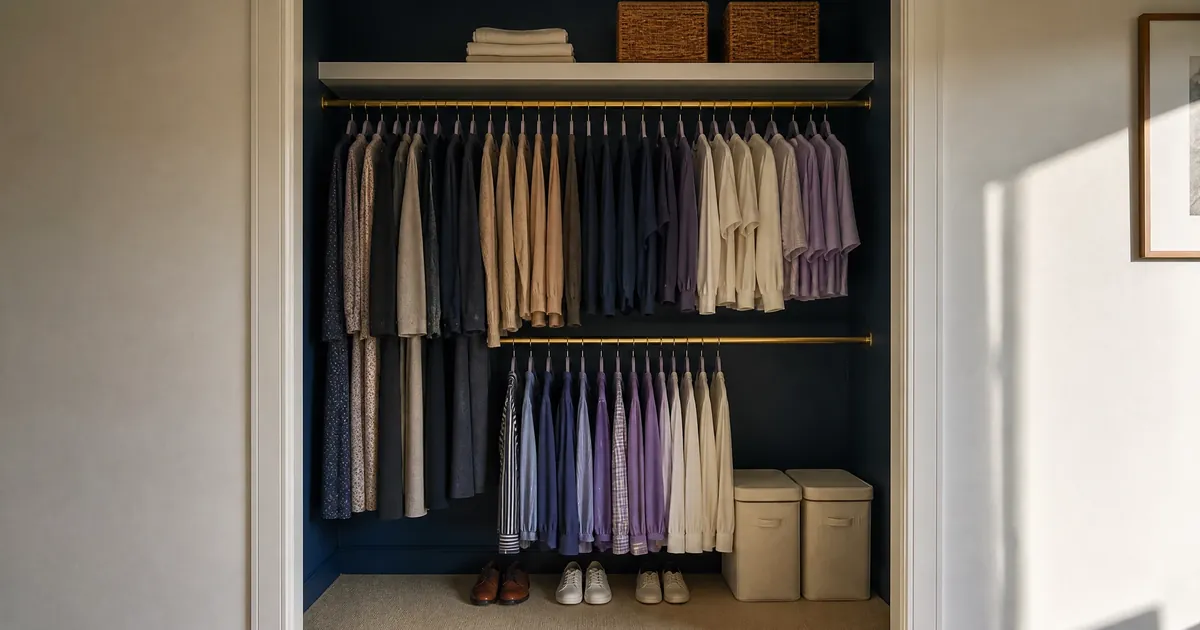
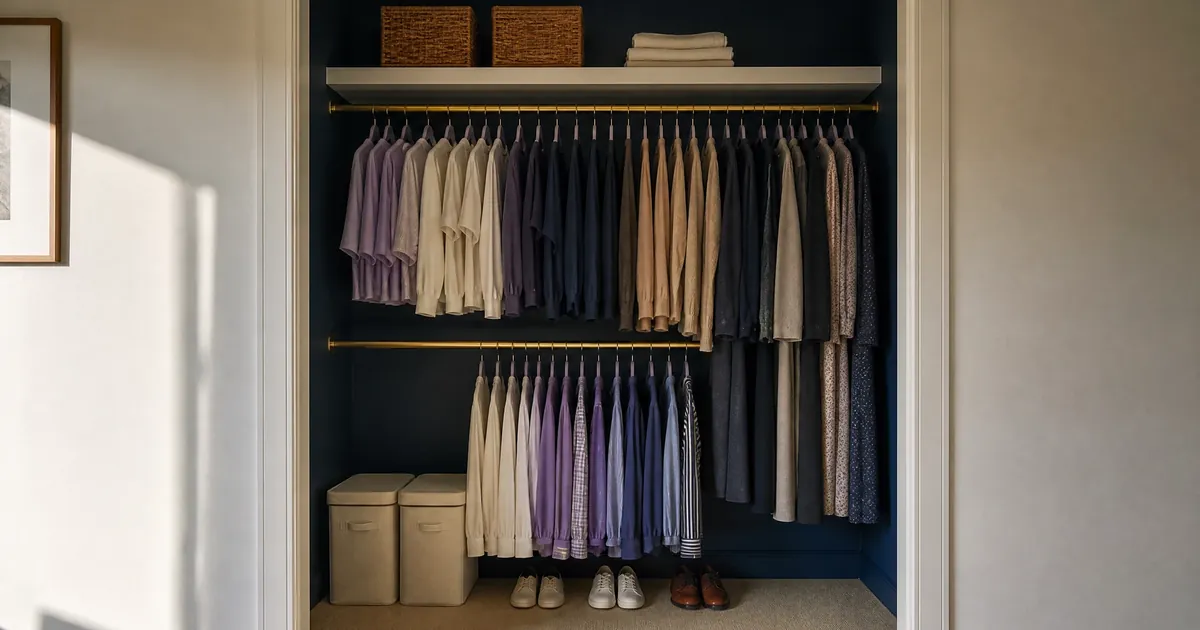
A reach-in closet gives you one rod, one shelf above it and a door that opens into the foot of the bed. It has to hold a coat, a dress, the four shirts you actually wear and the bag you take to work.
This is an order of spending, not a shopping list. Free work first, because most of the mess comes from layout rather than a shortage of containers. Then three purchases, in order of payoff. The hundred dollars is a ceiling, not a target.
No prices appear here, deliberately. Prices move, pack sizes change, and the same bin costs different amounts in different countries. What follows is what to spend money on and in what order; the arithmetic belongs to the shop you walk into.
For the shape itself, see the reach-in closet guide. For fixes that leave no holes, no-drill ideas is the fallback.
The free pass, before you spend anything
Two hours of unpaid work gets most of the way. Do it all before you open a shop tab, because half these jobs remove the need for something you were about to buy.
- Take out every wire hanger you can spare. They bend under a coat, snag knitwear and bunch on the rod so the whole rail slides when you pull one jumper.
- Carry the off-season clothes out entirely. A winter coat in July is dead weight, and the seasonal swap is the version that does not lose a boot.
- Group by length, not colour. Coats and long dresses at one end, shirts in the middle, trousers and short skirts at the other.
- If the shelf rests on pins rather than nails, drop it to the lowest setting that still clears your longest hanging item by a hand’s width.
- Use the containers you already own: shoe boxes, the tote from the last move. A mismatched box that fits beats a matching one that does not.
- Clear the floor. All of it. The reason is further down, but the floor is the first place a reach-in fails.
Grouping by length rather than colour looks like a small thing. It is not. A reach-in is viewed edge-on, so colour blocks read as a smear, and colour splits apart things that hang the same way: put a long coat between two shirts and it steals the air above both. Length blocks cluster what needs the same drop, leave one clean gap near the top of the rod, and show you where a second rod would fit.
If the out-pile is bigger than one bag, the thirty-day declutter plan is the slower, stickier route.
The first purchase: hangers that match
A hanger takes rod space even when it is empty. Every one has thickness at the shoulder, and the garment adds its own width on top. Wide wooden hangers and fat plastic tubes spend a slice of the rod before a single shirt is on them, and across a full rail it fills before the clothes do.
Thickness multiplied by count: measure one hanger at the shoulder and multiply by how many you own.
Replacing the lot with one slim type is the best-value purchase here, because it is the only one you touch every morning. Flocked hangers grip the satin and jersey that slide off plastic; plain slim plastic is cheaper and lets everything slide, which is faster when you are late and worse when you are not. Buy enough for the category that causes most trouble, usually shirts.
Packs are counted and priced differently from shop to shop, so buy the number you need at once. Topping up later is how a matched rail turns back into a mixed one.
The second purchase: bins sized to the shelf
Rods are visible, so they get fixed first. The shelf is where a reach-in actually fails: a stack of folded things that has to be excavated, and a front row that hides everything behind it.
Measure three things before any money moves. Depth from the wall to the shelf’s front edge. Clear height between the shelf and whatever sits above it. Width between the side walls at shelf height, because closets are rarely square.
Measure the shelf’s depth and the clear height above it before you buy a single bin, and write both numbers on your hand. A bin a hand too deep will not go back once the door shuts; one a hand too shallow leaves the shelf doing nothing.
Buy one size, lidded, and stack them in a single column. Identical bins are findable by memory: the jumper is the second one down. A grid of different boxes is a puzzle you solve every morning, and whatever ends up at the back of the top shelf is a thing you have thrown away.
The trap is a bin that overhangs the shelf edge. It looks generous until the door catches it on the swing, and it tips forward when you pull it because most of its weight sits past the edge it balances on. Keep it fully behind the front edge with a finger’s width to spare. If that costs a couple of litres, you have bought back the door.
The third purchase: a second rod, or a divider
Under the short garments there is a column of air doing nothing. A second rod there is the only purchase on this list that adds capacity rather than rearranging it, and it is the second reason length grouping matters: you can see where the short items end.
Doubling the hanging space covers the mechanics, so this stays on the decision. Two checks. The drop has to clear the longest thing you will hang below the first rod by a hand. The second rod has to sit far enough forward or back not to foul the first, which is a tape measure job rather than an optimism job.
If the drop is not there, a hanging divider is the alternative: a fabric column that hangs off the rod and gives you shelves for folded things. It costs one rod’s width of hanging space and returns a shelf, a fair trade in a closet with too many jumpers and a poor one in a closet short of rod.
The door swing, the light, and the floor
The door that opens into the bed
An inward-opening door gives a reach-in two depths: the depth when it is shut and the depth you can use when it is open. Behind the hinge that usable depth can be almost nothing, so the first stretch fills with things the door knocks over.
Keep the hinge end shallow and boring. Nothing tall, nothing stacked above shoulder height, nothing that overhangs a shelf, because the bin trap shows up here first. Long coats go at the far end. If the arc is still eating the floor, a curtain on a tension rod removes the swing and leaves no holes.
Light without wiring
A battery puck light or a stick-on strip changes a reach-in more than any container does, because these closets are lit by whatever leaks in from the bedroom. Buy one that switches on at a touch.
Honesty about adhesive: it fails on textured walls. Bubbled paint, woodchip, wallpaper: the strip grips for a week before it drops onto the rail. Clean the surface, let it dry, press for the whole cure time, and mount it where the door will not knock it. On a textured wall, do not fight it. A puck light resting on the shelf and aimed at the rod works and never falls.
The floor is not storage
The floor is where a closet dies. One pair of shoes, then the laundry basket, then a bag, and within a month you are stepping over things to reach the rod. Once the floor is occupied, the hem of every hanging garment is crushed.
Two exceptions that have to earn their place: the shoes you wear daily, and a folding step stool if you cannot reach the shelf without one. Everything else down there is a decision you have not made.
Where money does not help
Drawer dividers are the classic. They work when the drawer is sorted and the categories are stable. They fail the moment something does not fit its slot, because the slot becomes a suggestion and the drawer returns to a jumble. If you have never kept a divider system for a month, a second one will not be the one that works.
Matching baskets for a closet nobody sees are a decorating purchase wearing a storage label. Buy for function, meaning opaque, lidded, stackable and sized to the shelf, and let the set be mismatched. Nobody is coming to look.
Anything that needs a drill is a hole to patch and a decision you cannot take back in a rented flat. A reach-in rarely needs one. Leave the drill in the box.
What the hundred dollars is really for
The budget is not for making the closet look finished. It is for removing one piece of friction that happens daily, and the daily thing is the hanger. You touch one in the morning and again at night, and a rail of thick, mismatched, snagging hangers is a small tax on every one of those moments. That is why it gets paid first.
If the rail is already thin and matched and the shelf is the landslide, spend it on bins. If the clothes are sorted and the rod is still full, spend it on the second rod, the only purchase here that gives you space rather than order. The sequence is free pass, hangers, bins, rod, and you stop where the closet stops annoying you.
Most reach-in closets stop annoying their owner well before the ceiling. The hundred dollars is a cap, not a shopping list, and the best version of this project ends with part of it unspent and one bag of clothes leaving the flat.
The whole project, in 5 steps
- Clear the rod and sort by length Take out the off-season clothes and every wire hanger. Group what remains by how far it hangs rather than by colour: long coats and dresses at one end, shirts in the middle, trousers and short skirts at the other. Leave one clean gap.
- Replace the hangers with one slim type Buy one kind of slim hanger in a quantity that covers the whole category, not a handful to top up a mixed rail. Matching thickness gives every garment the same width and lets the hems line up, which is what makes a closet readable in the morning.
- Measure the shelf before buying bins Write down the shelf's depth, the clear height above it and the width between the side walls at that height. Buy lidded bins that sit fully behind the front edge with a finger to spare, and stack one column of the same size.
- Add a second rod or a hanging divider Check that the drop under the existing rod clears your longest short garment by a hand. If it does, add a second rod for shirts and trousers. If it does not, hang a fabric divider off the rod and use its shelves for folded things.
- Fix the light and empty the floor Mount a battery puck light or a stick-on strip on a smooth, clean surface, or rest it on the shelf if the wall is textured. Then clear the floor of everything except the shoes you wear daily and a folding step stool.
Questions that come up
Do I have to spend the full hundred dollars?
No. The free pass does most of the work, and matching hangers plus one stack of correctly sized bins covers the rest for most closets. Stop as soon as the closet stops being annoying in the morning.
Why group clothes by length instead of by colour?
A reach-in is seen edge-on, so colour blocks read as a smear and split apart garments that hang the same way. Grouping by length keeps a single drop together and shows where a second rod would fit.
Why can't a bin overhang the shelf edge?
The door catches it on the swing, and the bin tips forward when you pull it because most of its weight sits past the edge it balances on. Keep it fully behind the shelf's front edge.
Will an adhesive closet light stay on a textured wall?
Usually not. Adhesive needs a smooth, clean, dry surface, and textured or bubbling paint gives it nothing to hold. Rest a puck light on the shelf and aim it at the rod instead.
What if my closet door opens into the bed?
Keep the hinge end shallow: nothing tall, nothing stacked above shoulder height, nothing overhanging a shelf. Long items go at the far end, and a curtain on a tension rod removes the swing without any holes.