
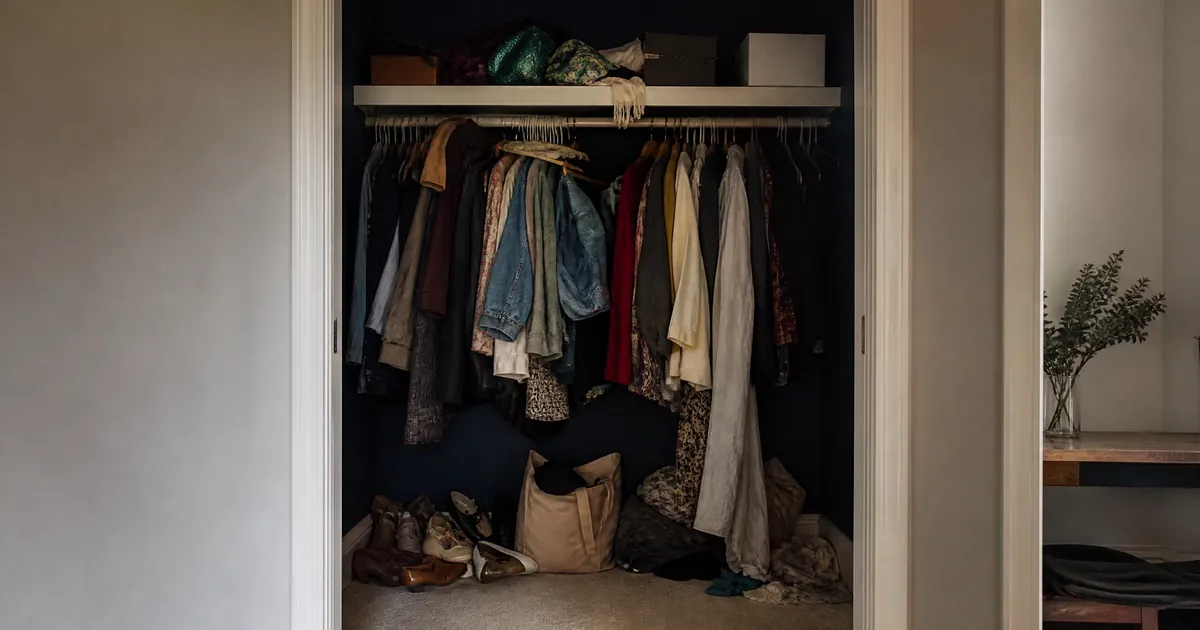
The one-weekend closet purge follows a script. Saturday morning you pull everything onto the bed, because that is what the guides say. By two in the afternoon the bed is a ridge of clothes and you have made four decisions and unmade three. By Sunday night most of it goes back in, and the closet looks the way it did on Friday with more folding.
None of that is a character flaw. Three things go wrong at once. You ask the same question, keep or not, dozens of times, until the answers stop meaning anything. You have nowhere to put the undecided items, so they become a pile with no address. And everything goes back into the container it came out of, which is why the result looks so familiar.
This plan spreads the same work across five phases and thirty days, with sessions short enough for a weeknight. The day-by-day tasks are on the 30-day declutter checklist. This article explains the part a checklist cannot: why the method works, where people quit, and what to do when a week goes sideways.
Phase 1, days 1–7: the surface pass
Week one is not about your clothes. It is about the layer you can see: the shelf you cannot reach past, the pile on the floor, the front third of the rail. Leave the boxes on the top shelf alone. You are not emptying anything this week.
Momentum is the reason. A shelf that stops avalanching makes the closet feel different by Wednesday, and that feeling buys the patience for week three. The hidden layer has waited this long. It can wait two more weeks.
Set three containers on the floor: keep, donate, toss. That is the three-container rule, and it means no decision hangs in the air. Keep goes back on the rail during the session, not later. Donate goes by the door. Toss leaves the apartment that evening.
A “maybe” box is a postponement with better branding. If something is genuinely undecided, give it a date, the last day of this phase, and decide it then. Anything still undecided on that date goes in the donate container.
That rule does more work than any storage product. The maybe pile is where a purge survives and comes back.
Phase 2, days 8–14: one category per session
Now work by category, not location. One session, one category: all the pants, then the knitwear, then the shoes, then the bags and belts. Gather every item of that category from the whole apartment, including the hook by the door and the bag under the bed.
A shelf is the wrong unit of work because a shelf holds six categories. You pick up a shirt, then a scarf, then a phone charger, and each needs a different decision. A single category lines up its duplicates: the fourth gray hoodie, the jeans that fit and the jeans you keep meaning to fix.
Compare within the category, not against an ideal. The question is not whether you like the garment but whether it is the version you reach for when you are late and the weather is wrong. Three black t-shirts, one soft, one with an annoying collar, one that shrank: that takes four seconds.
Put the survivors back on their own hangers as you go. Anything needing a repair you will not do this week goes in the donate container, not the drawer of good intentions.
Phase 3, days 15–21: the hard stuff
This is the week people stop: sentimental clothes, clothes for a body you used to have, and the formal outfit worn once that lives in a dry-cleaning bag.
Sentimental items can stay, but they need to stop being clothes. Fold the sweater your grandmother made into a lidded box and put it on the top shelf. It is a kept object now, not a garment competing for a hanger. You are not throwing the memory away, just moving it out of the middle of your Tuesday.
Skinny clothes get one box, not a rail. If you are actively working toward a different size, keep the pieces you would genuinely wear again and store them out of rotation. A lidded box under the bed does the job, and the reach-in closet guide for small budgets shows where those hide. If the clothes are several sizes and several years old, they are not motivation but a rebuke in fabric form.
The formal outfit is its own question. If it fits and you would wear it to the next wedding, keep it at the back in a breathable garment bag. If it needs altering, it is a project rather than an outfit, and projects need a date. Would you book the alteration this month? If not, it goes.
What not to declutter
Three things earn their space even if they went unworn this year: the winter coat that fits over a sweater, the shoes you would wear to an interview tomorrow, and the one good dress or suit for weddings and funerals. They are not sentimental. They are insurance, and replacing them costs a bad afternoon and money you did not plan to spend.
Phase 4, days 22–28: the exit
A bag in the hallway is not finished. It is furniture with a job title. Every donation and torn thing leaves the building this week, because a bag that stays becomes part of the apartment and gets picked through.
Sort the outgoing pile by destination before you move it:
- Clean and wearable: a thrift store, a clothing bank, or a shelter that accepts clothing. Check opening hours before you load the car.
- Stained, torn or worn out: a textile recycling drop-off, which takes fabric a thrift store cannot sell.
- Hangers, boxes and dividers: offer them to a neighbor, or put them out with the recycling your building actually collects. Check the rules rather than hoping.
- Actual trash: out tonight.
Then put the bags by the front door with your keys on top and take them on the next trip you were already making. If the donation point only opens on Saturday morning, that is your date, so put it in your phone.
This phase is light on decisions and heavy on logistics, which is why people skip it. The closet only feels different once the objects are somewhere else.
Phase 5, days 29–30: the reset
Put back only what survived. This is where a good declutter gets quietly undone: the empty rail looks like an invitation, and a storage system feels like a reward.
The reset is four small rules:
- Everything left has a place, and the place is inside the closet, not on the chair.
- The rod keeps a gap at one end. That gap is where tomorrow’s outfit goes and where a new purchase has to fit.
- Empty hangers go in the exit bag, not back on the rail.
- Nothing gets a label you cannot maintain.
That last one matters. Labeling is a hobby, and a label on a box you will not keep tidy becomes a small daily accusation. If your categories make sense, you do not need the label. If they do not, the label will not fix it.
When real life interrupts
Two things reliably happen around week three: you miss a few days, and the person you share the closet with keeps putting things back. Neither means the plan failed.
When you miss three days
The plan is a queue, not a calendar. When you come back, take the next session on the list and do that one. Do not catch up by running five days on a Sunday; the fifth session is where careless decisions get made just to make it stop.
Phases are counted in sessions, not dates. If day 30 arrives while you are still on the hard stuff, keep going; finishing on day 38 costs nothing. What breaks a declutter is restarting, which means week one happens twice and week three never happens.
Sharing a closet with someone who is not doing this
Do not declutter their clothes. It feels efficient and it is a household argument with a delay fuse. Split the rail into two zones, agree on the shared shelf (spare bedding, towels, the coats by the door), and leave their zone alone, including the parts that annoy you.
You can still do the useful half. Offer to take their donation bag with yours on the day 28 run and let them fill it on their own schedule. If one shared item is genuinely in the way, ask about that object rather than announcing a system. In a narrow reach-in with one rod, the boundary is often a divider or an agreed hanger color; the reach-in closet guide covers splitting a shallow rail without drilling.
Day 31: what the closet looks like
The floor is clear, so you can stand in front of the rail instead of beside it. There is a gap at one end of the rod. The top shelf holds a written-on box of sentimental things, a box of off-season clothes and little else, and you know which is which without climbing on a chair. The bag that lived in the hallway is in a car trunk or at the donation point.
The look matters less than the loop you have built. One thing in, one thing out: the new sweater displaces an old one that same week, not at the next purge. When the seasons turn, the changeover takes an afternoon because the off-season box is a known quantity; the seasonal clothing swap routine covers that handover. If your closet is a freestanding wardrobe, the phases still apply, and the wardrobe version covers what is different.
You will probably declutter again next year. That is fine. Thirty days was never about a forever closet. It was about making the next pass a short job instead of a lost weekend.
The whole project, in 5 steps
- Clear the visible layer first Spend the first week on what you can see: the floor pile, the front of the rail, the shelf you cannot reach past. Leave stored boxes alone, and put every item into keep, donate or toss as you go.
- Work one category per session Gather every item in a single category from the whole apartment, then compare them against each other. A category exposes duplicates that a shelf hides, and each session ends with one part of the closet genuinely decided.
- Decide the sentimental and someday clothes Give sentimental pieces a lidded box on the top shelf instead of a hanger. Keep one box of clothes for a different size, store it out of rotation, and settle the formal outfit by asking whether you would book the alteration this month.
- Move everything out of the apartment Sort donations by destination: wearable items to a thrift store or clothing bank, torn fabric to a textile recycling drop-off, hangers and boxes to a neighbor or the building recycling. Then take the bags on a trip you were already making.
- Put back only what survived Return the keepers to the rail, leave a gap at one end, and put empty hangers in the exit bag. Skip labels you will not maintain. One thing in, one thing out stops the result sliding back to where it started.
Questions that come up
Can I keep a maybe box instead of deciding?
No, and that is the point. A maybe box moves the decision somewhere you cannot see it. Give undecided items a fixed date at the end of the phase and let the date decide for you.
What happens if I miss a week of the plan?
Nothing breaks. The plan is a queue rather than a calendar, so you take the next session when you return. Do not stack several sessions into one evening, because that is when careless decisions get made.
How do I declutter a closet I share with a partner?
Leave their clothes and their side of the rail alone. Agree on the shared shelf and the coats by the door, then offer to carry their donation bag on your own drop-off run.
Which clothes should I never declutter?
A winter coat that fits over a sweater, shoes you could wear to an interview, and one good outfit for weddings and funerals. They are insurance rather than sentiment, and replacing them is expensive and inconvenient.
Do the thirty days have to be consecutive?
No. The five phases are counted in sessions, which is why finishing on day 38 or day 45 works just as well. Restarting from phase one is the only thing that reliably kills the plan.