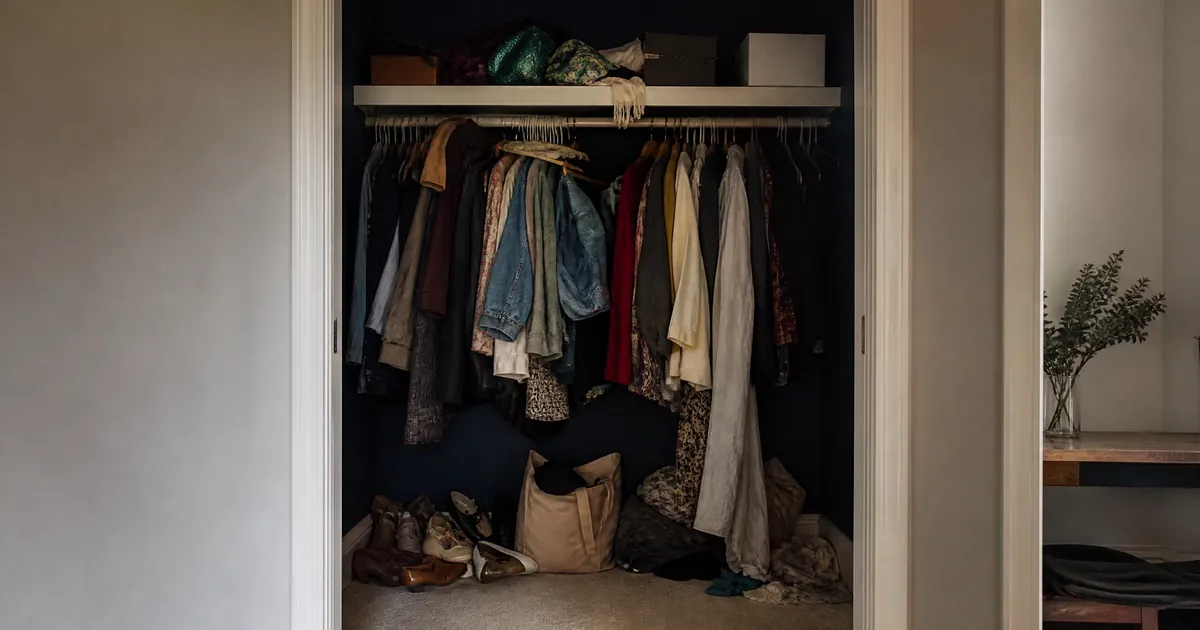

The swap itself is the easy part. You pull the box out from under the bed, put the sandals in, take the jumpers out, and for about forty minutes you feel like a person whose life is in order.
Then the box sits in the hallway. It sits there for three weeks, and every one of those weeks somebody opens it: to borrow a scarf back, to find the fleece that turns out to be needed in June, to shove it six inches sideways so the bathroom door will shut.
None of that is a character flaw. The swap failed because it never had a finish line. This is the two-hour version, where the box leaves the room in the same sitting and its destination gets decided before the first hanger moves.
Why the box ends up in the hallway
A full box in the hallway is not storage. It is a waiting room, and while it is within reach the off-season clothes are not put away, just on hold. The closet you cleared has a leak.
The fix is to name the box’s destination before you touch a hanger. Not “somewhere”, not “the cupboard in the hall if there is room”. A specific place you have already measured with a tape. If no such place exists, you do not have a swap to finish — you have a box to rehome, which is an easier decision on a Sunday afternoon than in a hallway at midnight.
The other half of the finish line is time. A swap that runs from lunchtime to dinner has already failed, because somewhere in hour four you will promise to finish tomorrow. Tomorrow is when the raiding starts.
Pick a date, not a forecast
Weather is a terrible project manager. A warm week in late October makes the swap feel optional. A cold snap in early April makes it feel urgent, which is worse, because urgency is how clothes end up shoved into a bag.
Choose a trigger that does not consult the sky:
- A fixed weekend you put in the calendar, the way you would a dentist appointment.
- The weekend the clocks change, which hands you a spare hour and a reminder in one event.
- The first morning you honestly need a coat. That one is weather, but it is an event rather than a prediction: you either needed the coat or you did not.
What matters is a date and a start time. “Saturday, ten o’clock, two hours” gets done. “Sometime in October” becomes the box in the hallway.
Two boxes, not five
A five-box system belongs to someone with a spare room. In a small flat, every extra box is another object that needs a home, and the home is the thing you do not have.
So: one box for what leaves, one for what arrives. Anything that fits neither gets decided in your hand, on the spot — worn this week, donated, or binned. Not “think about it”. Not a third box labelled maybe. The maybe box is the hallway box wearing a hat.
Two questions do most of the deciding:
- Did I wear it during the season that just ended? Not would I like to. Did I.
- Would I buy it again today, knowing what I know?
If both answers are no, it goes. If you are stuck on something that cost real money, keep it one more season and write the decision date on paper inside the box: one hand’s worth of items, not the whole pile.
The short list that stays out all year
Four things never go in either box: the black dress that works for a funeral and a wedding, the shirt you interview in, one warm layer that fits under a coat, and gym clothes. You need these with less than a day’s notice, and the point of seasonal storage is that the things you need are never in a box under the bed.
If the outgoing box is mostly things you should have dealt with a year ago, the thirty-day declutter plan takes the same decisions one task at a time.
Wash it, dry it, then close the lid
Everything goes into the box clean. Not aired-on-the-chair clean — washed, or at least laundered as far as the care label allows. Body oils, deodorant, a splash of dinner: all of it feeds the things that eat clothes, and none of it announces itself until you open the box months later.
Then dry it properly, which is a different job from making it feel dry. Moths and mildew both start with a damp, dirty item, and damp is the part you cannot see. A thick knit reads as dry long before the seams, the ribbing and the underarms do. Which is why the outgoing pile gets washed the day before: thick things need a night on the airer, not an hour on a radiator.
The damp-knitwear mistake: a jumper that spent an hour on the radiator is dry on the surface and wet in the middle. Fold it into a box in that state and you have built a small greenhouse with a lid. Give heavy knits a full day somewhere airy, or leave them hanging another week.
Cedar and lavender are worth using and worth being honest about. They are scent, not proof. They make a box smell like something you want to open and may put some insects off, but they do not kill anything and they will not rescue a damp jumper. Refresh them when the smell fades and let clean, dry clothing do the work.
Vacuum bags are for bedding, not for shoulders
Vacuum bags are the most useful thing here and the most misused. For duvets, pillows, spare bedding and the bulky quilt that lives on the sofa from November, they are excellent: press the air out, seal, and the shelf above the wardrobe has room again.
For anything with structure they are a bad trade. A padded coat, a blazer, a wool coat with a shaped shoulder — all of them depend on air and shape to look like themselves. Compress a shoulder into a flat fold for six months and it comes out creased where the shoulder used to be. Pressing does not quite bring it back. That is the crushed-shoulder problem, and it is why coats survive best stored flat or hanging.
Knitwear is its own case. Wool and cotton need to breathe, and sealed in plastic with the smallest moisture left in the fibre they pick up a mustiness no wash quite shifts. If a knit goes into a bag, it goes in bone-dry and comes out before the season turns.
The short version: bags for things you would happily sit on, hangers and folded stacks for things you would not.
Somewhere for the box to live
Settle this before the boxes come out, because it decides whether the swap sticks.
Four places that work in a small flat:
- Under the bed. Measure from the floor to the frame, then measure the box with its lid on. A flat lidded box slides in; a deep one does not, and you learn that on your knees.
- On top of the wardrobe. Measure from the unit to the ceiling, then subtract the height of the box and the space your fingers need under the lid. Freestanding wardrobes hold less than they look like they will, so check the wardrobe guide before buying a box to match.
- Behind the sofa. Only if it is not flat against the wall, and only if the depth is a measurement rather than an optimistic guess.
- Inside a suitcase you already own. It is storage that happens to have wheels. Fill it, close it, put it back where it lives.
Measure before you buy. The gap you are measuring is the one you have, not the one on the label. And if nothing fits, the box cannot leave the room, so the swap cannot finish — no-drill storage ideas cover the under-bed and over-door options that come out on move-out day.
The two-hour swap, start to finish
Two hours works if you spend them in the right order, with the wash already done and dry. The clock starts when the boxes come out.
- The first 20 minutes. Clear the bed and put both boxes on it. Open the wardrobe, set a timer, and check last night’s wash is genuinely dry; anything still damp goes back on the airer, not into a box. Then pull out what is obviously out of season and drop it on the bed unfolded. Speed beats neatness; you are emptying, not packing.
- The middle hour. Put the arriving clothes away first, by category, so the closet is useful before the mess is gone. Then work the outgoing pile with the two questions and keep moving. Nothing returns to the wardrobe because that was easier than deciding. Put the donation bag by the door, where it will actually leave with you.
- The last 40 minutes. Pack the box: fold flat, keep shoulders uncreased, add cedar or lavender if you use it. Close the lid, write the season on the side, and carry the box to the spot you measured. Take the empty box out too, then make the bed and close the wardrobe door.
The room should look like nothing happened, which is the trick. A swap that ends with a box in the hallway is not finished, it is paused, and it will stay paused for three weeks. One that ends with an empty bed, a closed box and a closet holding only this season’s clothes is done. The next swap is faster because the destination exists, and if you want more room on the rail afterwards, doubling the hanging space is a different afternoon’s work.
The whole project, in 5 steps
- Fix a date and a finish line Put the swap in the calendar with a start time, and choose the spot the full box will live in before you begin. The session ends when the box has left the room, not when the sorting feels done.
- Take out two boxes, not five One box for the season going out, one for the season coming in. Anything that fits neither gets decided in your hand: wear it this week, donate it, or bin it. No maybe box.
- Wash and dry everything before it is stored Wash the outgoing clothes as far as their care labels allow the day before, then let thick knits dry overnight so seams, ribbing and underarms are dry too. Moths and mildew both start with a damp, dirty item.
- Pack for shape, not for space Keep vacuum bags for duvets, pillows and bedding. Store padded coats, blazers and knitwear uncompressed, flat or hanging, so shoulders keep their shape and wool can breathe through the off-season.
- Carry the box to its measured spot Slide it under the bed, lift it onto the wardrobe or close it inside a suitcase, then carry the empty box back out of the room and make the bed. Close the wardrobe door and stop.
Questions that come up
Will a seasonal swap really take two hours?
Yes, if the boxes and the storage spot are ready and the washing was done the night before. A first swap in a very full closet can run longer, so book the whole evening if it is your first one.
Should seasonal clothes go into vacuum bags?
Only the soft, unstructured things: duvets, pillows, spare bedding. Padded coats, blazers and knitwear lose their shape in a sealed bag, and wool that cannot breathe can come out musty even when it went in dry.
Does cedar or lavender keep moths away?
It helps a little and proves nothing. Cedar and lavender add a scent some insects dislike, but they do not kill eggs or larvae, and they cannot rescue a damp item. Clean, dry clothing does most of the work.
Where can the off-season box go in a small flat?
Under the bed, on top of the wardrobe, behind a sofa that is not against the wall, or inside a suitcase you already own. Measure the gap before buying a box, including room for the lid and your fingers.
Which clothes should stay out all year?
The black dress that suits a funeral and a wedding, the shirt you interview in, one warm layer that fits under a coat, and gym clothes. These are the things you need with less than a day's notice.