A studio flat usually arrives with one of two things. Either no closet at all, or a cupboard so shallow that a coat hanger goes in sideways and the door never quite shuts. Either way the clothes end up on the chair by the bed, and the chair stops being a chair.
A wardrobe here is not one purchase. It is three decisions: which corner the clothes live in, what holds them up, and what hides them on the days you cannot be bothered. Get the first right and the other two take an afternoon.
What follows is how to pick the corner, four ways to hold the clothes, and what to check before you buy.
Start with the corner, not the furniture
Most people buy the rail first, then walk around the flat holding it, looking for somewhere it fits. Do it the other way round. A corner that suits your clothes will take almost any rail; a corner chosen to suit the rail will annoy you every morning.
Three things make a corner usable. It has to be at least as wide as the clothes you own, which is usually wider than you think. It has to sit off the route from bed to door, so you are not turning sideways at seven with a mug in your hand. And it must not block the radiator, the window you open or the light switch.
Then test it the slow way. Stand there for a full minute and do nothing. You will notice the draught, the door swinging into your left shoulder, and the kettle plug that is now behind where the coats would hang.
Measure afterwards, in lengths you already carry. A hand-span of rail holds roughly eight hangers, so thirty hangers wants about four hand-spans, plus a hand at each end. The rail needs depth too: a hanger is about as wide as your shoulders, and clothes hang across it. If the gap between wall and bed is narrower than a hanger, that corner is a shelf.
The open rail, and the three things that make it look deliberate
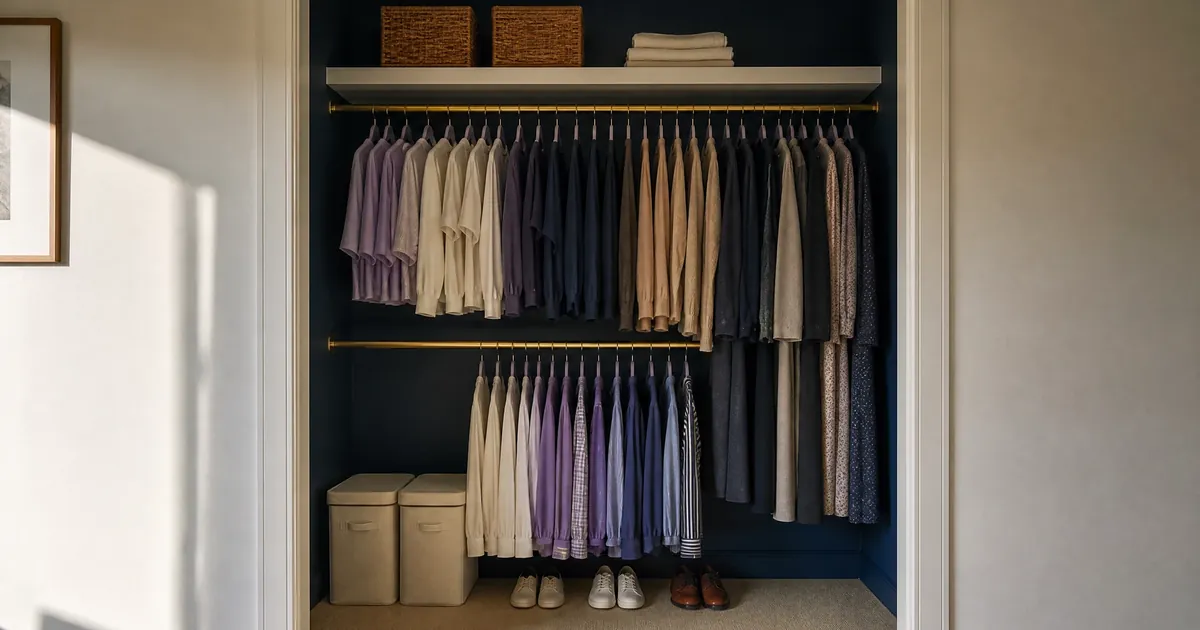
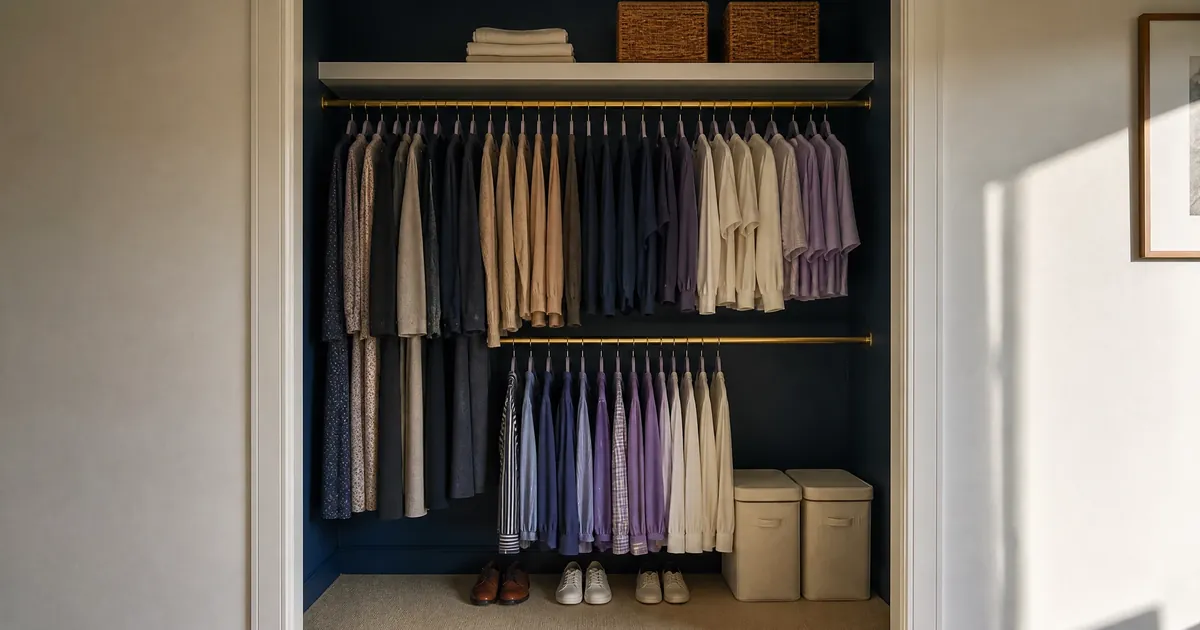
The simplest version is a freestanding rail with a shelf above it. The shelf caps the arrangement with a horizontal line, holds folded jeans and a basket, and stops the whole thing reading as a shop floor.
Three details do the rest.
- One hanger type. Same shape, same colour, same thickness, all the way along. Mixed hangers make an open rail look like laundry, because the eye reads the zigzag of plastic before it reads the clothes.
- An order that runs short to long. Hang by length so hems step down from jackets at one end to shirts at the other, and keep colours in blocks within that. It takes four minutes and is the difference between a wardrobe and a rail of stuff.
- A box on the bottom. A lidded box or a deep basket on the floor under the rail, wide enough for shoes. It grounds the arrangement, hides the least attractive things you own, and gives you somewhere to drop a bag.
The honest downside is dust, which settles on the shoulders of whatever faces the room. The other is exposure: there is no hiding a bad week. If half-folded laundry on the floor would make you feel worse rather than better, skip to the curtain.
The curtained corner
A rail plus a curtain gives you the rail when it is open and a plain wall when it is shut. Two ways to hang the fabric: a track fixed to the ceiling, or a tension track wedged between two opposing walls.
The tension option is the renter-friendly one, but it only works if the walls are genuinely parallel and close enough for the span. Old flats are rarely square. Test before buying with a tape at both ends of the gap; a couple of fingers of difference across a doorway is enough to make a track bow or slip. It holds the curtain, not the clothes.
Ceiling fixings are a different conversation, and usually a written one.
Check the ceiling before you buy anything that screws into it. Knock along the line where the track would sit: a hollow, papery answer usually means plasterboard over a void, and a track screwed into that will bring a patch of ceiling down with it. Ask your landlord in writing. If the answer is no, a tension track or a screen does the same visual job.
The wardrobe box with a lid
If you want the clothes out of sight, a lidded wardrobe box is the whole answer: a tall cupboard on the floor, usually flat-packed, with a rail inside and a lid on top.
Four things to look for.
- A rail inside the box, not a shelf above one. Under a fixed shelf you will lift every hanger over a lip twice a day. The rail should run the full width, high enough that shirt shoulders clear the lid.
- A lid you can open with one hand. Hinged with a stay, or split in two so one side folds back. Anything needing both hands means putting the shirt down first, and you will stop bothering.
- Size taken from your longest coat, not the label. Measure shoulder to hem, then add a hand for the hanger hook. A box a hand too short is a box where one coat lives sideways on the floor.
- Something you can move. Castors, or a flat-pack that comes apart again. A solid box that will not go round the stair bend is a box you leave behind.
The trade-off is floor space and clear room in front to open the lid. It suits a room that is messy by default; in a corridor-shaped studio, every centimetre of floor is also a walkway.
A screen or a fabric panel as a visual wall
When every fixing question gets a no, a folding screen becomes the wardrobe’s front door. It is the cheap, reversible option: it stands on its own, needs no wall, folds flat at the end of the tenancy, and doubles as somewhere to change in a room without a bathroom door.
A fabric panel does the same job for less floor. Hang a length from a tension rod inside a recess, or across the gap between two bookcases, so it reads as a wall rather than a curtain over clothes. Choose a light colour and stop it a hand below the ceiling; a dark panel that touches the ceiling makes a small room feel like a cupboard.
A screen hides, it does not seal. Dust still finds the clothes, and a screen in front of a radiator traps heat. Treat it as a visual wall first and storage second.
What lives on the rail, and what lives in the drawers
Once the wardrobe exists, the argument moves to what goes where, and one rule settles most of it: one motion.
Count the movements between standing up and holding the garment. On the rail it is one, a reach and a lift. In a drawer it is two or three: open, unzip, find. Anything you wear on a weekday morning should take one motion, so daily clothes live on the rail and anything behind a zip, buckle or lid sits lower down.
It is not a tidiness rule. It is about how many small decisions you make before coffee. Gym kit in a zipped bag belongs in a drawer, packed on Sunday. The coat you wear twice a winter belongs in a box, not at the end of the rail.
Under-bed and over-door are overflow, not the main event
Both are worth having, and neither should hold anything you need on a Tuesday. Under-bed boxes are for out-of-season clothes and spare bedding, because kneeling at seven is a decision you stop making by week two. Over-door hooks are for one coat, one bag and the keys, on a door that still closes.
When the seasons turn, move the whole box rather than individual pieces, which keeps the rail honest and stops the overflow becoming a second, worse wardrobe. The routine is in the seasonal clothing swap guide.
Before you buy a rail
A short list to run in the shop, in the order that saves returns.
- Width. As wide as your clothes plus a hand at either end. Count hangers at home first: a hand-span holds about eight.
- Height. Rail low enough that a shirt hem clears the floor by a hand, shelf low enough to see what is on it without a stool.
- Depth. At least a hanger’s width from the wall, or clothes hang at an angle and the shoulders crease.
- Feet. Wide enough that a full rail does not tip when you pull a coat off one end; narrow feet on carpet are the usual failure.
- Getting it home. Can you carry the longest piece up the stairs alone, and does it fit the lift.
- What is in the box. Wall straps and screws you may not be allowed to use, plus a spanner size you do not own.
- Finish. Something you can wipe, because the shelf above an open rail is where dust lands.
- The return window. Keep the packaging flat until the rail has survived a week of mornings.
If the rail is a stopgap, the reach-in closet guide covers the cupboard-with-a-rod version, and the wardrobe guide goes further on freestanding setups. For everything without a drill, no-drill ideas is the index.
Two hours, one corner, and Tuesday morning stops starting on the floor.
The whole project, in 5 steps
- Choose the corner before the rail Pick a wall at least as wide as the clothes you plan to hang, away from the bed-to-door route, the radiator and the window you open. Stand in the spot for a full minute, then walk the morning route and check your shoulder clears it.
- Set up the open rail Stand the rail in the corner, add the shelf above it, and hang everything on one type of hanger. Rehang in length order, short to long, then put a lidded box or basket on the floor underneath so the arrangement finishes on a solid shape.
- Hang a curtain on a track Fix a ceiling track only if your tenancy allows it and the ceiling will hold a screw. Otherwise choose a tension track, checking first that the two walls are parallel and close enough for its span. The curtain hides the rail; it does not carry clothes.
- Choose a lidded box if you want things hidden Look for a rail inside the box rather than a shelf above it, a lid that opens with one hand, and a height worked out from your longest coat plus a hand. Check that it comes apart and fits the stairs.
- Move the weekday clothes to the rail Count the motions between standing up and holding a garment. Anything that needs one motion, a reach and a lift, belongs on the rail. Anything behind a zip, a buckle or a lid goes in a drawer, a box or under the bed.
Questions that come up
Can I build a wardrobe without drilling any holes?
Yes. A freestanding rail, a lidded box and a folding screen all stand on their own, and a tension track only presses against two walls. Ceiling fixings are the one part that needs your landlord's agreement.
How wide does a clothes rail need to be?
Wide enough for your hangers plus a hand at each end. A hand-span of rail holds about eight hangers with clothes on them, so count what you own before you buy anything.
Will a tension track hold a curtain over clothes?
It holds the curtain, not the clothes. The garments hang on a freestanding rail set in front of it, so the track only carries fabric. It also needs two opposing walls that are actually parallel.
How do I keep an open rail from looking like a shop floor?
Use one hanger type throughout, hang by length so hems step down from short to long, and put a lidded box on the floor underneath. Those three details do most of the work.