A ninety-centimetre hallway is not a design problem. It is a physics problem. The door has to open, a person has to get past, and the shoes have to live somewhere in that gap.
Most entryway storage advice assumes you have a wall to spare. You have a strip of floor, a door that swings, and whatever vertical space survives the coat hooks.
Here is the plan for that strip: the shoes you are not wearing, the cabinet, the door organiser, the bench.
Count the shoes you actually wear
Before you buy anything, put every pair you own on the floor in one room. Most people find the same thing: a winter boot, trainers with a broken lace, and several pairs belonging to a version of your life you are not currently living.
An entryway is a staging area, not an archive. Its job is to hold the shoes you will put on in the next seven days. Everything else, from occasion shoes to the sandals in November, wants a lid and a label, under the bed or on a shelf you need a chair to reach. The seasonal swaps guide covers that end of the job, including how to pack shoes so they come out uncreased.
Be honest about the rotation. Work shoes, trainers, boots when it rains: that is three or four pairs by the door. The rest are not an entryway problem any more. They are a storage problem, and storage has more places to hide than a hallway does.
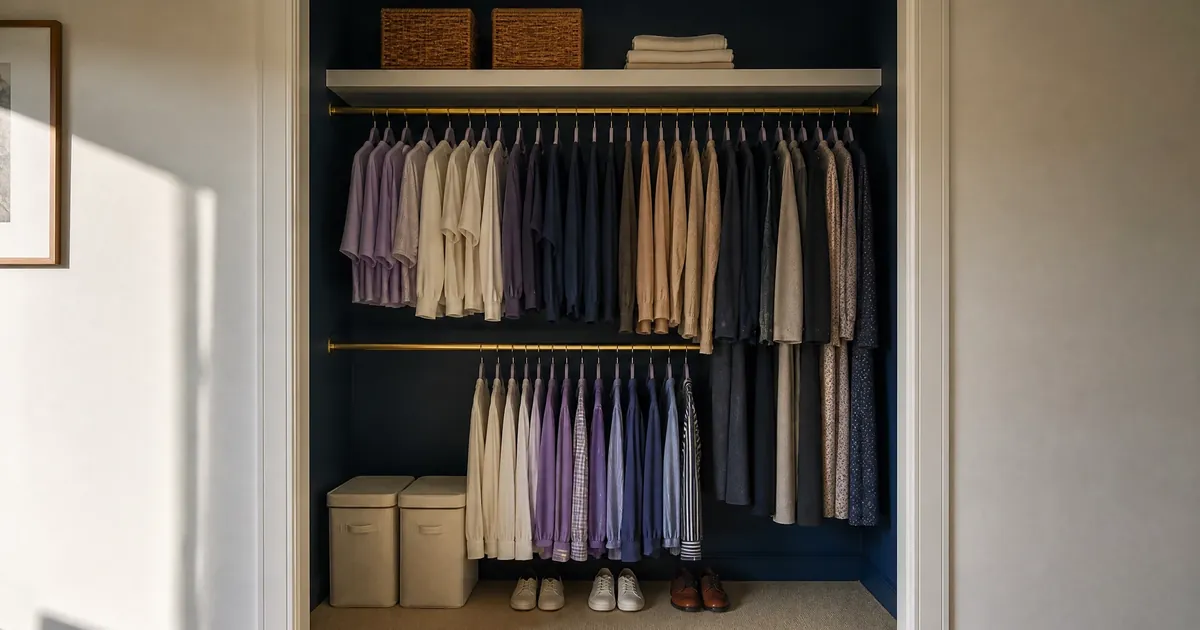
If your flat already has a shallow closet by the door, the entry closet guide is the better place to start.
Measure the door swing before you buy a cabinet
A slim tilt-out shoe cabinet is the obvious answer for a narrow entryway, and often the right one. Three checks come before any money changes hands.
Depth first. A cabinet is useful only if it is deeper than your shoes are long, and placeable only if it is shallower than the gap you have. Measure your longest pair heel to toe, add a hand’s width for the tilt to swing, and compare that with the wall run. Something that only swallows flat shoes is a cabinet for one season.
Open the door to ninety degrees and mark where its leading edge sits on the floor. Measure from that mark to the nearest wall. That gap is dead space. The door needs it every time it opens, and nothing can live there, however slim it is.
Then the anti-tip question. Tilt-out cabinets are front-heavy by design: the doors hinge at the bottom, so pulling one open moves the weight forward and the whole box wants to follow. Most ship with a strap for the top, and it is there for a reason. If your lease rules out screws in plaster, look for a cabinet that fixes with an over-the-top strap, keep the heavy pairs at the back, and open one door at a time. If none of that feels secure, choose a different shape.
Then the top. It sits somewhere between knee and hip height, which makes it the best drop zone in the flat for keys, post and whatever has to leave tomorrow. That is useful, and it is also how a tidy cabinet becomes a heap in a fortnight. Decide now what lives there: one tray, one plant.
Over-the-door pockets: check the door, not the organiser
An over-the-door pocket organiser asks nothing of your walls. It hangs on the door’s top edge, the hinges carry the load, and the pockets swallow flip-flops, gloves and the scarf you keep forgetting.
It works on a hollow door, which surprises people. A hollow door is a thin skin over a card core: it will not hold a screw, but it will carry a hanging organiser, because the weight travels over the top edge and down the face rather than into the panel.
It fails in specific places. Sliding doors have no top edge within reach and no leaf that swings clear, so the pockets foul the track. A tight frame, with barely a finger of gap above the door, will not close once the strap is over the top: you will hear the scrape, then take the organiser off again. A door that opens flat to the wall has nowhere for the pockets to go.
The test takes ten seconds. Hang it empty, close the door slowly and listen. Then load one pocket and repeat.
One tenancy note. The over-door hooks are harmless. The adhesive hooks people add to stop the bottom swinging are not, because adhesive strips on painted wood can lift paint when they come off, and a pale patch above a door handle is what a landlord photographs at inspection. Keep those in a drawer.
For more ways to hang things without a drill, start with the no-drill ideas hub.
A bench you can sit on
Most hallway storage treats the bench as a lid for whatever is underneath. That is backwards. The sitting is the point, because putting shoes on is the moment the system gets tested, and doing it one-handed against a wall every morning is what makes a hallway hateful.
Buy for the seat. Knee height, or a little under, so your feet rest flat. Deep enough that your thigh sits on it rather than an edge, because a shallow bench slides away as you lean down.
Underneath, open baskets beat drawers. A basket takes a bulky thing: a folded raincoat, an unopened parcel, the shoes of someone who is not currently in the flat. It slides out with a foot while both hands are full. A deep drawer looks neat in photographs and is useless when you are wearing one shoe.
Two baskets are enough: one for the shoes in play, one for whatever arrives at the door.
Put the bench on a side wall, out of the door’s swing. The floor at the threshold has to stay clear, for reasons below.
Ladder shelves and lidded boxes: the dust question
Two more things fit a wall this narrow.
- A leaning ladder shelf. It needs no fixings and turns a thin strip of wall into four or five open shelves. It is also a dust trap shaped exactly like a shoe: dust settles on every pair, and shoes go back while faintly damp, which turns dust into something closer to mud.
- A stack of lidded shoe boxes. These keep dust off and look calmer. Choose boxes that open from the front, with a drop-front or a shallow drawer, rather than lift-lid boxes. A lift-lid tower is unpacked from the top down, so the pair you wear least sits behind four others. A front-opening stack lets you pull one drawer and shut it. Label the front, not the lid.
Never put a damp pair away in a closed box or a shut cabinet. Trapped moisture is how shoes go soft, white and unwearable over a winter. Lidded storage is for dry shoes only.
One in, one out, and where the wet boots go
Storage that never empties is a pile with better manners. The rule that keeps a tiny entryway workable is one in, one out, on the same day. A new pair arrives, a pair leaves: archive box, donation bag, or bin. If you want help making those calls, the 30-day declutter plan has a version that does not demand ruthlessness at eight in the morning.
The February problem
Wet boots break every tidy system, and February is when they arrive. A soaked pair needs air on all sides, so it cannot go into a lidded box, a closed cabinet or a zip-up bag. Give the boots a tray at the end of the bench, out of the walking line, and turn them once a day. Keep them away from radiators, because heat dries leather too fast and cracks it. Newspaper inside pulls the moisture out overnight.
What the building rules say
Some rules outrank the storage plan. Check these before anything goes into the hallway.
- Never block the front door, the fire exit, or the route between them. If a cabinet has to move before the door opens fully, it is in the wrong place.
- Keep the floor clear at the threshold. Baskets left in the door’s swing become trip hazards in the dark.
- Find out whether your building bans storage in shared corridors. Many do, and the rule tends to cover a doormat-sized shoe rack as much as a bike.
- Keep your things inside your own front door. A shared corridor is an escape route, not extra hallway.
And anything held on with adhesive can take paint with it when it comes off. Test a hidden spot first.
The five-shoe rule
If you remember one thing, make it this. A tiny entryway holds about five pairs comfortably, one for each weekday, and the rest live in the archive box. Not because five is a magic number, but because five is roughly a week’s rotation once you count work shoes, trainers and boots. Count on a Sunday. Anything above five is not a storage problem any more; it is a decision you have not made yet.
The whole project, in 5 steps
- Sort this season's shoes onto the floor Bring every pair into one room and put the ones you have worn in the last week to one side. The rest go into a lidded box with a label, stored under the bed or on a high shelf, not in the hallway.
- Measure the door swing and the free wall Open the door fully, mark where its leading edge lands, and measure from there to the nearest wall. Compare that clear run against the depth of your longest pair of shoes before you choose a cabinet.
- Hang the organiser and close the door Hang the pocket organiser empty on the top edge of the door and close it slowly, listening for a scrape against the frame. Load one pocket and repeat. If the door will not shut, the organiser is the wrong shape for that doorway.
- Set the bench on a side wall and fill two baskets Place the bench where you can sit with both feet flat and the door still opens past it, then slide two open baskets underneath. One holds the shoes in play, the other holds whatever arrives at the door.
- Choose a leaning shelf or a front-opening stack Pick open shelving if you will dust it weekly, or lidded boxes that open from the front if you will not. Keep damp shoes out of both, and label the front face rather than the lid so you can find a pair without unstacking.
Questions that come up
Will a shoe cabinet block my front door?
Only if it sits inside the door's swing. Open the door fully, mark where its edge lands, and keep that arc empty. A cabinet past the mark, against a side wall, leaves the doorway usable.
Do over-the-door shoe organisers work on sliding doors?
No. Sliding panels have no exposed top edge to hang from and no leaf that swings clear, so the pockets catch on the track. They also need clearance above the door for the strap, which tight frames do not have.
Where should wet boots go in a small hallway?
On a tray at the end of the bench, out of the walking line and away from radiators. Never in a lidded box or a closed cabinet, because trapped moisture softens leather. Turn them daily and stuff newspaper inside overnight.
How many pairs of shoes should stay by the door?
About five, which is roughly one week's rotation for one person. Everything else is archive rather than entryway, and belongs in a labelled box somewhere with more room. Count on a Sunday and move the extras out.
Can I use adhesive hooks on a painted door?
They can lift the paint when they come off, which is a move-out problem rather than a storage one. Test one in a hidden spot first, and prefer over-door hooks that hang on the top edge and need no adhesive at all.